
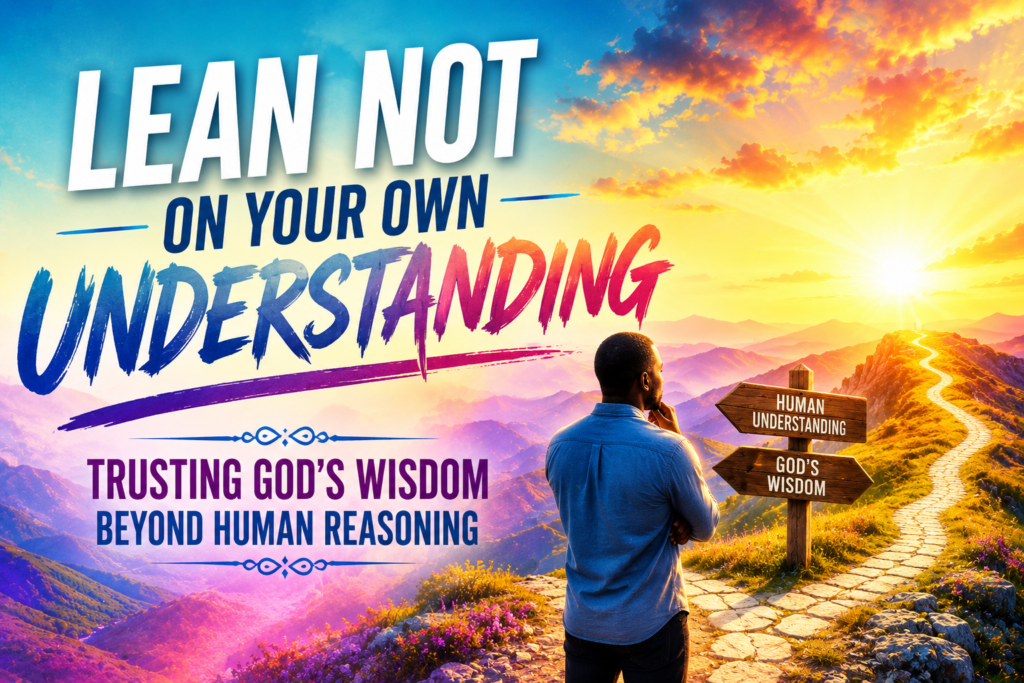
One of the greatest battles in the Christian life is not always the battle against sin. Sometimes, it is the battle between human reasoning and divine wisdom.
Human beings naturally trust what they can explain, predict, and control. We feel safe when things make sense. We feel secure when outcomes are visible. Yet the Kingdom of God often functions beyond the boundaries of human logic.
The Bible says in The Bible Proverbs 3:5–6, “Trust in the Lord with all thine heart; and lean not unto thine own understanding.”
Notice carefully that Scripture did not say understanding is evil. Understanding is valuable. Logic is useful. Wisdom is important. But the danger begins when human reasoning becomes the highest authority in a believer’s life.
There are times when God’s instructions will challenge your intellect. There are seasons where divine direction will not align with visible evidence. This is because God leads from eternity while man reasons from limitation.
Many believers delay obedience because they are waiting for God’s instructions to make complete sense naturally. But in the Kingdom, obedience often comes before explanation.
The challenge is that human understanding always wants guarantees. Faith, however, requires trust.
This is why spiritual maturity is impossible without surrender.
The Limitations Of Human Understanding
Human understanding is limited.
No matter how intelligent a person is, human reasoning is still confined by time, experience, emotions, and visible information. But God sees the complete picture.
A child may become upset because a parent refuses a certain request, not realizing the parent can already see consequences the child cannot understand yet. In the same way, many believers become frustrated with God because they interpret life from a limited perspective.
Imagine holding one puzzle piece in your hand without seeing the complete image on the box. The single piece may appear confusing and meaningless. But once the full picture is revealed, every piece suddenly makes sense.
This is how divine wisdom operates.
The Bible says in Isaiah 55:8-9 “God’s ways are higher than our ways and His thoughts higher than our thoughts”. That means there are dimensions of God’s wisdom that cannot be fully comprehended through human reasoning alone.
Logic can interpret facts, but only God sees destiny completely.
Many times, what appears unreasonable to man is already perfected within God’s wisdom.
This is why believers must learn humility before God. A person who insists on understanding everything before obeying God will eventually struggle spiritually because there are dimensions of divine leading that transcend human explanation.
Why God’s Instructions Often Challenge Logic
One of the patterns throughout Scripture is that God’s instructions often challenge natural reasoning.
When Jesus told Peter to cast his net again after fishing all night unsuccessfully, the instruction did not make logical sense. Peter was an experienced fisherman. He understood the waters. He understood the timing. Human reasoning had already concluded there was no possibility of success. Luke 5:5 “But Simon answered and said to Him, “Master, we have toiled all night and caught nothing; nevertheless at Your word I will let down the net.”
Yet one instruction from Jesus changed everything. 6 “And when they had done this, they caught a great number of fish, and their net was breaking”.
Think about Jericho. Imagine being a soldier prepared for battle only to receive an unusual strategy from God: march around the city walls instead of attacking conventionally. “You shall march around the city, all you men of war; you shall go all around the city once. This you shall do six days” (Joshua 6:3)
Human logic would call that foolishness.
Or think about the wedding at Cana in John 2:7 -9. where Jesus instructed servants to fill water pots before turning water into wine. 7 Jesus said to them, “Fill the waterpots with water.” And they filled them up to the brim. 8 And He said to them, “Draw some out now, and take it to the master of the feast.” And they took it. Many of God’s methods appear strange to human understanding because divine wisdom operates differently from human systems.
If God’s instructions always made perfect sense naturally, faith would not be necessary.
Sometimes God deliberately leads believers beyond their comfort zones so dependence on Him can deepen. Divine instructions are not merely about achieving outcomes. They are also about transforming the believer internally.
God is not only interested in results. He is interested in trust.
The Danger Of Leaning Only On Logic
There is a danger in depending only on human reasoning.
Overdependence on logic can weaken spiritual sensitivity. This is because the human mind naturally resists what it cannot control.
The children of Israel made this mistake when they saw the giants in Canaan. Instead of focusing on God’s promise, they focused on visible obstacles. Their reasoning became stronger than their faith.
Fear always grows when visible evidence becomes greater than divine revelation.
Peter also experienced this tension. When Jesus began speaking about His coming suffering and crucifixion, Peter rebuked Him because the plan did not fit human expectation – Matthew 16:22 “Then Peter took Him aside and began to rebuke Him, saying, “Far be it from You, Lord; this shall not happen to You!”. Peter loved Jesus sincerely, yet his reasoning could not comprehend God’s redemptive strategy.
This is important because sincerity alone is not enough. Human understanding without spiritual discernment can become a barrier to obedience.
Many believers miss divine opportunities because they are trying to calculate everything naturally. They want every risk removed, every detail explained, and every uncertainty eliminated before movement begins.
But God rarely works that way.
There are seasons where God will intentionally lead you beyond what your mind can comfortably explain so that your trust in Him can mature.
Logic without discernment eventually produces limitation.
Faith: Trusting God Beyond Explanation
Faith is trusting God beyond explanation.
Faith does not mean believers stop thinking intelligently. Rather, faith means God’s wisdom becomes higher than human conclusion.
A patient may not understand every detail of a complicated surgery, yet trust the surgeon because confidence is placed in the surgeon’s expertise. In the same way, believers trust God because of His integrity.
This is the foundation of faith.
Abraham demonstrated this beautifully. God instructed him to leave his homeland without revealing every detail about the destination ahead. Genesis 12:1 (NKJV) “Now the LORD had said to Abram: ‘Get out of your country, From your family And from your father’s house, To a land that I will show you.”
Human reasoning would demand full explanation before movement. But Abraham obeyed because faith trusts God’s character.
Please understand this carefully: faith is not the absence of questions. Faith is the decision to trust God despite unanswered questions.
Many believers want certainty before obedience, but faith moves while still depending on God for clarity.
Mature believers understand that God’s integrity is more reliable than visible circumstances.
Jesus: The Perfect Example Of Complete Trust
When we study the life of Jesus Christ, we see perfect surrender to the Father’s will.
In Gethsemane, Jesus prayed, “Not my will, but thine be done.” That statement reveals one of the deepest dimensions of trust.
Jesus understood the pain ahead. He understood the suffering, rejection, betrayal, and crucifixion that awaited Him. Yet He surrendered completely to divine purpose.
This is maturity.
There are seasons where God’s processes may feel uncomfortable temporarily, yet those same processes produce eternal outcomes.
Think about a seed planted into the ground. To the natural eye, burial appears like death. Yet hidden within that process is multiplication and fruitfulness.
In the same way, many believers misinterpret difficult seasons because they only evaluate present discomfort instead of eternal purpose.
Jesus trusted eternal wisdom above temporary comfort.
This is the essence of surrender.
How God Develops Trust In Believers
Trust is not developed instantly. Trust grows through process.
1. Consistent Obedience
One of the ways God develops trust is through consistent obedience. Every act of obedience strengthens spiritual confidence for future seasons.
2. Waiting seasons
Waiting seasons are also important. Many believers dislike waiting because waiting exposes impatience and the desire for control. Yet waiting often deepens dependence on God.
3. Depend on God completely
A person learning to swim must eventually release dependence on the edge of the pool. In the same way, believers must learn to depend fully on God.
4. Exercise your faith
Faith grows through exercise.
Muscles become stronger through resistance. Likewise, spiritual trust grows through situations that require believers to depend on God beyond natural ability.
5. Prioritize intimacy with God
Intimacy with God is also essential because trust grows through relationship. The more believers know God’s character, the easier it becomes to trust His leadership even when understanding is incomplete.
This is why consistent fellowship with God is important. Confidence in God is built through relationship, not merely information.
The Reward Of Trusting God Completely
There is always a reward for trusting God completely.
Many testimonies in Scripture were born through what appeared to be irrational obedience. God honors faith rooted in trust.
When believers stop trying to control everything, peace becomes possible. Anxiety often grows from the illusion that human control can guarantee safety.
But true peace comes from surrender.
Think about passengers inside an airplane. They remain seated peacefully during turbulence because they trust the pilot’s ability even when visibility is poor.
This is how faith operates.
God often guides believers through seasons they do not fully understand, yet His wisdom remains perfect.
Peter experienced the miraculous the moment he stepped out of the boat. Had he remained dependent only on logic, he would never have experienced walking on water.
Surrendering control to God often becomes the doorway to supernatural manifestation.
Conclusion — The Call To Trust God Fully
God never asked believers to understand everything before obeying Him.
The Christian life requires trust beyond feelings, logic, visible evidence, and human certainty.
There will be seasons where God’s methods remain unclear. Seasons where divine timing feels uncomfortable. Seasons where obedience stretches human reasoning. Yet mature believers continue trusting because they know the character of the One leading them.
A child can sleep peacefully inside a moving car because trust in the driver removes fear.
This is what God desires from believers.
The greatest proof of trust is not complete understanding. It is continued obedience even when God’s methods remain unclear.