
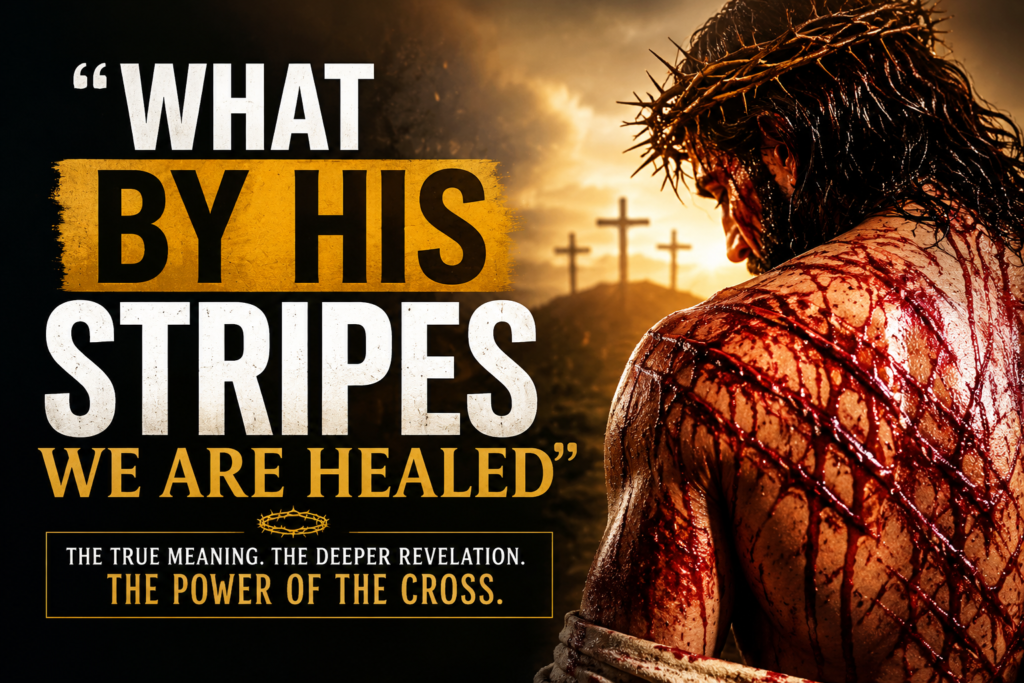
There are certain Scriptures believers quote almost automatically. They have become part of Christian vocabulary. One of them is Isaiah 53:5:
“But He was wounded for our transgressions, He was bruised for our iniquities: the chastisement of our peace was upon Him; and with His stripes we are healed.”
I was quoting this scripture for a long time without truly grasping the meaning. I just said it whenever I am sick and if it doesn’t work, I move on. But recently, I started meditating on it and it began to work for me. The problem is not the scripture, but my heart. I had to train my heart to believe the word and once it did, I started seeing results.
Many believers repeat this verse during sickness, pain, or difficult seasons just like me, but beyond the confession lies a deeper question: What exactly did Jesus accomplish through His stripes?
Was Isaiah only talking about physical healing? Does this verse guarantee believers will never face sickness? Why do some people pray and recover instantly while others endure long battles? And what does the suffering of Jesus truly reveal about the heart of God?
To understand the meaning of “By His stripes we are healed,” we must move beyond emotional Christianity and step into revelation. Because the cross of Jesus was not merely a moment of pain—it was a divine transaction.
The suffering of Jesus was intentional.
Every wound spoke. Every stripe carried meaning. And Calvary accomplished far more than many believers realize.
The Prophetic Weight of Isaiah 53
One of the most astonishing things about Isaiah 53 is that it was written hundreds of years before Jesus walked the earth. Isaiah saw the suffering Messiah prophetically long before Roman soldiers ever touched Him.
Imagine a man describing a crime scene centuries before it happened.
That is the mystery of prophecy.
Isaiah did not merely see a man dying. He saw a divine exchange taking place. Humanity had accumulated a debt it could not pay. Sin had corrupted creation. Pain, sickness, fear, death, and separation from God became the inheritance of man after the fall in Eden.
And then Isaiah saw Someone step forward to carry it all.
The chapter paints a shocking picture:
“He hath borne our griefs, and carried our sorrows…”
The language is heavy. The word “borne” suggests carrying a burden that belonged to someone else. Jesus did not suffer because He deserved suffering. He suffered as a substitute.
This is important to understand because Christianity is built upon substitution.
Jesus took what belonged to us so we could receive what belonged to Him.
He took sin so we could receive righteousness.
He took rejection so we could receive acceptance.
He took death so we could receive life.
And according to Isaiah, He also took wounds so humanity could receive healing.
What Were the “Stripes” of Jesus?
When most people hear the word “stripes,” they imagine small marks on the back of Jesus. But Roman scourging was far more brutal than many realize.
Before crucifixion, prisoners were whipped using an instrument designed specifically for torture. Historians describe a whip embedded with pieces of metal, bone, and sharp fragments. As it struck the body, it tore flesh apart.
The goal was not merely punishment. The goal was humiliation, weakness, and public destruction. By the time Jesus carried the cross, His body had already endured unimaginable trauma.
Now pause for a moment and think deeply about this.
The Son of God could heal the blind with a touch as seen in Matthew 8:3 “Jesus reached out his hand and touched the man. ‘I am willing,’ he said. ‘Be clean!’ Immediately he was cleansed of his”.
He could raise the dead with a word as seen in Luke 7:14-15 “Then He went up and touched the coffin, and those carrying it stood still. “Young man,” He said, “I tell you, get up!” And the dead man sat up and began to speak! Then Jesus gave him back to his mother.
He could silence storms with His voice as seen in Luke 4:39 “He got up, rebuked the wind and said to the waves, “Quiet! Be still!” Then the wind died down and it was completely calm.” Yet He stood silently while men tore His flesh apart.
Why?
Because redemption is costly.
There are dimensions of freedom that cannot be received until a price is paid.
A person may walk into a luxury store and admire an expensive item, but admiration alone does not transfer ownership. Payment does.
In the same way, healing was not established merely because God felt emotional compassion toward humanity. A price had to be paid for redemption to remain just.
The stripes of Jesus were not random acts of cruelty. They were part of the legal transaction of redemption.
Does “Healing” Only Mean Physical Healing?
This is where balance becomes important.
Some believers reduce healing to physical sickness alone. Others swing to the opposite extreme and claim Isaiah 53 refers only to spiritual salvation.
The truth is broader and more beautiful.
Jesus came to heal the whole man.
Human beings are spirit, soul, and body. Therefore, redemption addresses every dimension of brokenness.
There are people whose bodies are healthy but whose hearts are shattered. They smile publicly but secretly battle anxiety, trauma, rejection, or fear.
Others are financially successful but spiritually empty.
Some are alive physically but dead inwardly.
The healing ministry of Jesus consistently revealed that God cares about the complete restoration of man.
Notice how Jesus dealt with people in Scripture. Sometimes He healed bodies. Sometimes He restored dignity as seen in John 8:10-11 when he restores the dignity of a woman caught in adultery. “ Jesus straightened up and asked her, “Woman, where are they? Has no one condemned you?” No one, sir,” she said.
Sometimes He forgave sins first before addressing physical conditions as seen in Matthew 9:6 “But I want you to know that the Son of Man has authority on earth to forgive sins.” So he said to the paralyzed man, “Get up, take your mat and go home.”
This is why healing in Scripture often extends beyond medicine. It touches shame, fear, sorrow, oppression, torment, and hopelessness.
There are wounds doctors cannot detect with machines.
Yet Christ heals those too.
Why Did Jesus Have to Suffer?
This question troubles many people. Why could God not simply forgive humanity without the suffering of Jesus?
Because God is not only loving—He is also just. If a judge ignores crime completely, society collapses. Justice requires payment.
The cross reveals the perfect meeting point between mercy and justice.
Sin opened the door to death and corruption in creation. Humanity became disconnected from the life of God. Sickness, decay, and suffering became part of the human condition.
Jesus came as the final sacrifice.
Galatians 3:13 says: “Christ hath redeemed us from the curse of the law, being made a curse for us…”
Notice the language carefully.
He became the curse. This means the cross was an exchange. Jesus stepped into the position humanity deserved.
Imagine someone paying the debt of a prisoner moments before execution. The prisoner walks free not because he was innocent, but because someone else absorbed the penalty.
That is the mystery of Calvary.
And this is why believers must never treat the suffering of Jesus casually. The stripes were not symbolic decorations of religion. They were evidence of substitution.
Healing vs Divine Health
There is also an important distinction believers must understand between healing and divine health.
Healing restores what has been damaged.
Divine health sustains wholeness.
For example, if someone recovers from an illness, that is healing. But divine health points to a lifestyle where the life of God continually strengthens and preserves a person.
Think of it this way.
Repairing a broken building is healing.
Building with superior strength from the beginning reflects divine health.
God’s desire is not merely to rescue believers during emergencies. He desires that His people walk in wisdom, vitality, and spiritual alignment.
This includes practical stewardship too.
Many believers pray intensely for healing while consistently violating basic principles of rest, nutrition, peace, and balance. Faith is powerful, but wisdom matters too.
You cannot continuously ignore your body and expect spiritual maturity to cancel every consequence.
God heals miraculously, but He also teaches stewardship.
Why Do Some Believers Still Battle Sickness?
This is one of the most sensitive questions in Christianity.
If healing is part of redemption, why do sincere believers still suffer?
The answer requires humility because not every situation can be explained perfectly.
Sometimes the issue is lack of revelation. Many believers know healing intellectually but do not truly believe it deeply enough to stand upon it.
Other times unbelief and fear interfere with faith. James describes the unstable man as someone tossed back and forth like waves. James 1:6.
In some situations, there are genuine spiritual attacks. Scripture clearly reveals that Satan oppresses bodies and minds.
Then there are cases connected to wisdom. A person cannot continually abuse their health while expecting supernatural exemption from every outcome.
But there is another dimension many mature believers eventually discover: God’s processes are not always instant.
Sometimes healing happens immediately.
Sometimes progressively.
Consider how Jesus healed the blind man in Mark 8. The first time Jesus prayed, the man said, “I see men as trees, walking.”
The miracle had begun, but it was not complete yet.
That alone destroys the idea that every divine intervention must happen instantly to be authentic.
Believers must also avoid condemning people who are sick. One of the cruelest things religion does is make suffering people feel spiritually inferior.
Compassion must remain central to the Gospel.
Jesus never mocked the weak. He helped them.
The Ministry of Jesus Revealed God’s Heart
One of the clearest ways to understand God’s will concerning healing is to study Jesus Himself.
Acts 10:38 says “How God anointed Jesus of Nazareth with the Holy Ghost and with power: who went about doing good, and healing all that were oppressed of the devil…”
Notice the pattern. Jesus healed repeatedly.
Blind eyes opened – Mark 10:46-52, John 9:1-7 and Mark 8:22- 25
Lame men walked – John 5:8-9, Matthew 15:30 and Matthew 21:14
Tormented minds found peace – Mark 5:1-20, Mark 9:14-29 and Mark 4:24
Broken lives were restored – John 10:10
And He did not heal reluctantly.
This is important because Jesus perfectly revealed the Father. He said, “If you have seen Me, you have seen the Father.”
That means the compassion of Jesus reveals the nature of God.
Imagine a doctor who enjoys watching patients remain sick while claiming to love them. That contradiction would disturb anyone.
In the same way, the ministry of Jesus consistently revealed God’s desire to restore, deliver, and heal.
This does not mean believers will never face battles. But it does reveal that healing is not foreign to God’s character.
How to Receive Healing by Faith
One of the greatest frustrations in the body of Christ is hearing powerful truths about healing yet never experiencing them personally.
Many believers sincerely ask, “If healing belongs to us in Christ, how do we actually receive it?”
1. Have faith in God
The answer begins with understanding that faith is not emotional excitement. Faith is confidence in the integrity of God and His Word.
A sick person can cry and still not believe. Another person may be weak physically yet possess deep spiritual conviction.
Faith is not noise. Faith is persuasion.
Romans 10:17 says: “So then faith cometh by hearing, and hearing by the word of God.”
This means genuine faith grows through revelation. You cannot consistently believe what you have never truly understood. This is why many people remain defeated in areas where they lack light.
Imagine trying to withdraw money from a bank account you do not know exists. The resources may already belong to you legally, but ignorance prevents access.
In the same way, many believers know God can heal, but they are not convinced He wants to heal them personally.
Faith begins when the will of God becomes clear in your heart.
This was why Jesus often asked people questions before healing them.
“Do you believe?”
Not because He lacked power, but because faith creates alignment between the believer and the promise of God.
2. The Power of Words
Another important dimension of receiving healing is the power of words.
The Bible says life and death are in the power of the tongue. Many people pray for healing passionately but spend the rest of the day speaking fear, defeat, and hopelessness.
Faith does not ignore symptoms, but it refuses to make symptoms the highest authority.
There is a difference.
For example, if a doctor tells someone they have a serious condition, wisdom says they should address it responsibly. But faith says the final verdict still belongs to God.
The believer learns to speak in agreement with God’s promises instead of surrendering entirely to fear.
3. Thanksgiving
Thanksgiving is another powerful key many overlook.
In all four Gospels, Jesus repeatedly demonstrated gratitude before manifestations occurred. Gratitude keeps the heart anchored in trust instead of panic.
Fear magnifies problems.
Thanksgiving magnifies God.
4. Consistency
Consistency also matters greatly. Sometimes believers become discouraged because healing does not happen instantly. But throughout Scripture, there are miracles that occurred progressively.
Faith is often tested in the space between prayer and manifestation.
This is where many people quit.
Imagine planting a seed today and digging it up tomorrow because you do not yet see a tree. Spiritual things require patience, endurance, and trust.
Healing by faith is not a formula to control God. It is a posture of dependence, trust, obedience, and confidence in His nature.
And sometimes the greatest evidence of faith is not shouting loudly in public—but quietly refusing to give up on God in private.
Common Misunderstandings About Healing
There are many extremes surrounding this subject.
Some people think faith means pretending symptoms do not exist. But biblical faith is not denial. Faith acknowledges God’s truth above circumstances while still remaining honest.
Others assume anyone who remains sick lacks faith. This is dangerous and deeply insensitive.
Faith is not a competition.
And not every battle is visible externally.
Another misunderstanding is that seeking medical help means lack of faith. But throughout history, God has used wisdom, medicine, and skilled professionals to help people.
Luke himself was a physician.
Miracles and medicine are not enemies.
God is the source of wisdom.
The danger comes when believers place their trust entirely in human systems while excluding God completely. But using practical help while trusting God is not unbelief.
Balance matters greatly in spiritual matters.
The Greatest Healing of All
As powerful as physical healing is, it is still temporary. Every healed body will eventually grow old. Every earthly life still faces mortality. But salvation addresses eternity.
The greatest miracle is not merely a restored body—it is a restored relationship with God.
A man can be physically healthy and spiritually lost.
A woman can possess wealth, beauty, and success while remaining empty inwardly.
The deepest sickness of humanity was separation from God. And this is the ultimate reason Jesus came.
The cross was not merely about extending earthly comfort. It was about reconciling humanity back to the Father.
That is why the Gospel remains the greatest healing message ever preached.
Conclusion — The Cross Still Speaks
When Isaiah declared, “By His stripes we are healed,” he was unveiling a mystery far deeper than positive confession.
He was revealing the cost of redemption.
The stripes of Jesus remind us that God did not watch humanity suffer from a distance. He stepped into human pain personally.
He entered sorrow.
He entered suffering.
He entered brokenness.
And through His sacrifice, He made restoration available to humanity.
This does not mean believers will never face battles. But it means sickness, sin, and brokenness do not have the final word.
The cross still speaks.
And every stripe on the body of Jesus remains a testimony that redemption was paid for in full.