
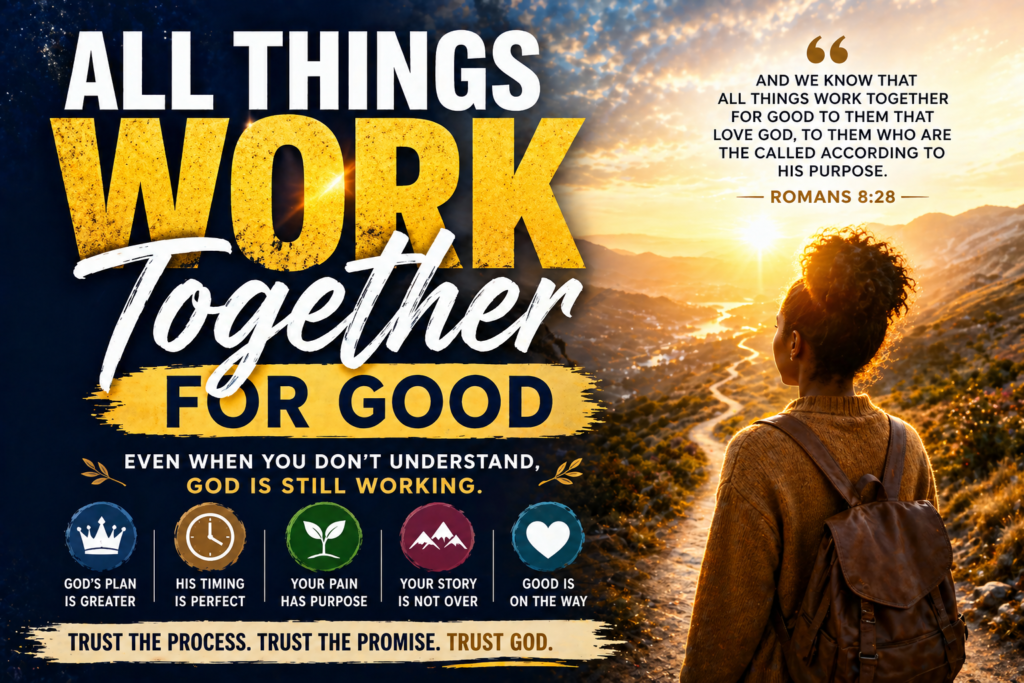
Scripture Focus: Romans 8:28
“And we know that all things work together for good to them that love God, to them who are the called according to His purpose.”
This is one of the most quoted scriptures in difficult seasons.
When things fall apart, when prayers seem unanswered, when life does not go according to plan—someone will say, “Don’t worry, all things work together for good.”
But if we are honest, there are moments when this statement feels disconnected from reality.
Because not everything looks good.
Not everything feels good.
And certainly, not everything seems to be working.
So the question is: Is this scripture truly reliable, or is it just a comforting statement we use to cope?
The answer is this: It is true—but it is deeper than most people understand.
The Condition Many Ignore
Romans 8:28 is powerful, but it is also conditional.
It does not say all things work together for good for everyone.
It says:
- “To them that love God”
- “To those who are called according to His purpose”
This means the promise is relational and positional.
It is for those who:
- Have a genuine love for God
- Are aligned with His purpose
Many people claim the promise but ignore the condition.
You cannot live disconnected from God’s will and expect divine orchestration to work in your favor.
What “All Things” Really Means
One of the biggest misunderstandings is assuming that all things are good.
That is not what the scripture says.
It says all things work together for good.
There is a difference.
Not everything that happens is good:
- Pain is not good
- Betrayal is not good
- Loss is not good
But God has the ability to take everything—both good and bad—and weave it into a purposeful outcome.
Think about cooking.
Salt alone is unpleasant.
Flour alone is dry.
Oil alone is not appealing.
But when combined properly, they create something beautiful.
In the same way, God uses every ingredient of your life—even the bitter ones.
The Mystery of Divine Orchestration
God is not reacting to your life—He is orchestrating it.
Behind every delay, every detour, every disappointment, there is a divine intelligence at work.
Genesis 50:20 says: “You intended to harm me, but God intended it for good…”
This was Joseph speaking.
What looked like betrayal was actually positioning.
What looked like delay was preparation.
What looked like rejection was redirection.
God does not waste experiences.
He converts them.
Biblical Examples of This Principle
Joseph: From Pit to Palace
Joseph was:
- Betrayed by his brothers
- Sold into slavery
- Falsely accused
- Thrown into prison
Nothing about his journey looked “good.”
Yet every step was leading him to the palace.
If Joseph had judged his life in the pit, he would have concluded God had failed him.
But the full story revealed divine strategy.
Job: From Loss to Restoration
Job lost everything—family, wealth, health.
But in the end, God restored him beyond what he lost.
The process was painful, but the outcome was purposeful.
Jesus: The Cross That Looked Like Defeat
The greatest example is Jesus.
The cross looked like failure.
It looked like injustice.
It looked like defeat.
But it became the gateway to salvation.
Sometimes, what looks like the end is actually the beginning.
Why It Doesn’t Always Feel Good
If everything is working for good, why does it feel so painful?
Because God’s definition of good is not the same as yours.
You define good as:
- Comfort
- Speed
- Favourable outcomes
But God defines good as:
- Growth
- Transformation
- Alignment with purpose
Hebrews 12:11 says: “No discipline seems pleasant at the time, but painful. Later on… it produces a harvest of righteousness and peace.”
Good is not always immediate—it is often eventual.
The Role of Trust in the Process
You will not always understand what God is doing.
But you are not called to understand—you are called to trust.
Proverbs 3:5-6 says: “Trust in the Lord with all your heart and lean not on your own understanding…”
Imagine a child watching a surgeon operate.
To the child, it looks harmful.
It looks painful.
It looks confusing.
But the surgeon knows exactly what he is doing.
In the same way, God sees what you cannot see.
What Happens When You Resist the Process
When you resist God’s process:
- You prolong your season
- You repeat lessons
- You increase frustration
Many delays are not from the devil—they are from resistance.
God is more committed to your transformation than your comfort.
How to Position Yourself for “All Things Working for Good”
Romans 8:28 is not automatic—it is activated by positioning.
God’s power is available to all, but His orchestration is experienced by those who are aligned.
Positioning is what allows divine intelligence to interpret your life correctly.
1. Love God Genuinely (Make Relationship Your Foundation)
The scripture begins with a condition: “to them that love God.”
This is not emotional affection—it is demonstrated devotion.
Jesus said in John 14:15: “If you love Me, keep My commandments.”
To love God means:
- He is your priority, not an option
- You choose Him even when it is inconvenient
- Your decisions reflect His Lordship
Why this matters: Love keeps you connected.
And connection is what allows God to guide, correct, and direct your life.
Without love, you may quote the promise—but you won’t experience it.
2. Stay Aligned With His Purpose (Don’t Live Outside the Blueprint)
The verse continues: “called according to His purpose.”
This means your life must be moving in the direction of God’s assignment, not just your desires.
Many frustrations in life come from misalignment.
You can be sincere—but sincerely outside God’s will.
God is committed to His purpose—not your preferences.
For example, consider a GPS Navigation
If you take a wrong turn, the system recalculates—but it keeps leading you back to the intended destination.
In the same way, God’s orchestration works best when you cooperate with His direction.
Ask yourself these questions:
- Is this decision aligned with God’s Word?
- Does it move me closer to purpose or away from it?
Alignment activates orchestration.
3. Maintain Faith in Difficult Seasons (Trust Beyond Understanding)
Faith is what sustains you when evidence is absent.
There will be seasons where:
- Nothing makes sense
- Prayers seem unanswered
- Doors appear closed
But this is where many people disconnect.
Hebrews 11:6 reminds us: “Without faith it is impossible to please God…”
Faith says:
- “Even when I don’t see it, God is working.”
- “Even when I don’t understand it, I trust Him.”
You don’t need full clarity—you need consistent trust.
Because doubt interrupts alignment, but faith sustains it.
4. Respond Correctly to Adversity (Your Reaction Determines Your Outcome)
What happens to you is important—but how you respond is more important.
Two people can go through the same situation:
- One becomes bitter
- The other becomes better
The difference is response.
Romans 12:21: “Do not be overcome by evil, but overcome evil with good.”
When adversity comes:
- Choose gratitude instead of complaint
- Choose prayer instead of panic
- Choose growth instead of blame
A good example here is Pressure and Diamonds
Pressure can break something—or it can transform it into something valuable.
Your response determines which one happens.
5. Remain Spiritually Sensitive (Discern What God Is Doing)
Not everything happening in your life is random.
Some things are:
- Tests
- Instructions
- Redirections
But if you are not spiritually sensitive, you may misinterpret them.
Isaiah 30:21 says: “You will hear a voice behind you, saying, ‘This is the way; walk in it.’”
Sensitivity allows you to:
- Recognize divine timing
- Avoid unnecessary delays
- Respond to God’s leading quickly
Practical Ways to Stay Sensitive:
- Maintain a consistent prayer life
- Stay rooted in the Word
- Avoid spiritual distractions
- Obey promptly when God speaks
6. Embrace the Process (Don’t Rush What God Is Building)
Many people love the promise—but resist the process.
But the process is where:
- Character is built
- Capacity is developed
- Purpose is formed
Ecclesiastes 3:11 says: “He has made everything beautiful in its time…”
Not immediately—in its time.
If you rush the process, you risk missing the purpose.
God is not just trying to bless you—He is trying to prepare you.
7. Stay Consistent (Spiritual Stability Produces Results)
Positioning is not a one-time decision—it is a lifestyle.
Consistency is what allows God to build something lasting in your life.
Many believers are:
- Hot today
- Cold tomorrow
- Committed in crisis
- Casual in comfort
But God works best with stability.
James 1:8: “A double-minded man is unstable in all his ways.”
Consistency keeps you in position long enough for God’s plan to unfold.
Below are examples to make it easy to understand:
Think about a Puzzle
One piece looks meaningless—until you see the full picture.
The Movie
A painful scene makes no sense until the end of the story.
The Construction Site
Before a building is completed, it looks messy and chaotic.
But the architect sees the finished structure.
Conclusion: Trust the Process, Not Just the Promise
Romans 8:28 is not a comfort statement—it is a revelation.
It is not saying life will always feel good.
It is saying God is always working.
So don’t judge your life in the middle of the process.
Don’t conclude too early.
Because what looks like a setback today may be a setup for tomorrow.
Philippians 1:6 says: “He who began a good work in you will carry it on to completion…”
God is not finished.
And until He is finished— everything is still working.